Saturday, February 5, 2011

Window Bird Collisions


It’s probably happened to you. You’re enjoying the view of watching birds at your backyard bird feeding station when suddenly they spook due to a Cooper’s hawk. They burst, scattering in all directions and one bird, let’s say a white-throated sparrow, sees a small opening of sky and bushes and heads for it in order to escape. It’s a fatal mistake. Although the sparrow avoided the clutches of the hawk, the small natural opening that it thought meant freedom turned out to be the reflections of a window. The sparrow hits it with full force, partially breaking its bill and hemorrhaging its brain. You’ve heard the thud and run outside to check on it and find it dead beneath the window. But make no mistake, even if the bird has flown away, chances are it will perish from its injuries. This sparrow can now be added to an annual tally of birds that have died from colliding into windows and buildings which conservationists estimate ranges between 100 million and 1 billion birds a year; this cause of mortality ranks among the top three causes for bird decline among North American birds and may be the number one quantifiable cause.

A variation of this experience happens with larger commercial buildings. With both the use of glass in general, and the use of reflective glass as the main type, growing in popularity, many glass-facaded commercial buildings have become significant sources of bird mortality. This problem is magnified when trees are planted near the building. Migrating birds see the reflection as reality, and seeking the sky or tree the reflection presents, unwittingly fly into the glass with lethal force. Unfortunately, it is not unusual for dozens of birds to perish at problematic buildings as they navigate on migration through urban centers like New York, Boston, Chicago, Toronto, and San Francisco. Long Island buildings pose a problem too. Fifty two golden-crowned kinglets, several warbler species and yellow-bellied sapsuckers died in one day flying into an all-glass building situated in Great Neck as they migrated south this past October. All-glass buildings at the Jericho and Huntington Quadrangles are also known to kill birds.

Fortunately, there is a technological answer to the problem. Unlike humans, birds can see ultraviolet light. Window and window film manufacturers are taking advantage of this ability by making windows and easily applied window films that reflect UV light. Windows so equipped, instead of deceiving birds, inform them that the windows are solid objects that should be avoided. And since we cannot see UV light these solutions pose no aesthetic concern.

The Huntington-Oyster Bay Audubon Society is working with New York State Assemblyman Steve Englebright (D-Setauket) to introduce legislation in the 2010 NY State Legislative session to begin to address this issue. While all the elements of the draft legislation have not been finalized, it is expected to require new public and private construction to use bird friendly window designs, and to establish a 15-member Bird Friendly Building Council charged with researching various issues relating to the problem and developing proposed solutions, including a program to retrofit existing “problematic” buildings. We’ll keep you informed as this important legislation takes shape over the next couple of months and works its way through the state legislative process.

And what to do to prevent that white-throated sparrow from becoming a victim at your home? Here are several things you can do to deal with window collisions:

  • Because collisions are caused by birds attempting to fly through glass, or because they see the reflections of the sky and trees and are unable to recognize the glass as a solid object, be sure to break up or eliminate their view by placing decals on your windows, ideally one-quarter-inch wide, white, vertical stripes spaced four inches apart, or one-eighth-inch, black, horizontal stripes spaced one inch apart.
  • If you feed birds in your yard, move the feeders and bird baths to within three feet of your window. The birds cannot gain enough momentum at this close range and you greatly decrease the chance that they will get hurt. If this is not possible, move them at least thirty feet.
  • Move inside plants away from windows so that birds do not mistake them for outdoor habitat.
  • Consider using screens, bars or film on your window to eliminate reflections. If you can, purchase bird safe glass to have installed.
  • If you are landscaping your yard, try to place trees and shrubs away from your windows in order to prevent reflections in the glass that look like a continuation of your yard.
For more information on how to make your home bird friendly, please see: http://www.allaboutbirds.org/NetCommunity/Page.aspx?pid=1184 and ww.abcbirds.org/abcprograms/policy/collisions/pdf/collisions_flyer.pdf

John Turner/Stella Miller

Wednesday, January 26, 2011

Why Cats Belong Indoors


Why Cats Belong Indoors

It’s 10am. Do you know where Fluffy is?

If you are like many people, and allow your cat to roam outdoors, there is a distinct possibility that at this moment, Fluffy is stalking an unaware bird, ready to pounce with deadly accuracy. “But wait, Fluffy is well fed”, you say. That doesn’t matter. Cats do not always hunt because they are hungry. They hunt because of an innate instinct for hunting. They hunt because it is, dare I say it, fun. “Well, Fluffy wears a bell and that will serve as a warning”, you say. No again. A bell is useless. Wildlife does not recognize the sound of a bell as a danger signal and even if they did, most cats learn to stalk and seize their prey silently, despite the presence of a bell on their collar.

Cats as our companions

Cats are companion animals, just as dogs are. They were domesticated thousands of years ago in Egypt and were brought to the United States a couple of hundred years ago. Cats evolved from wild species but are now considered their own separate species, Felis catus. Although they retain many of their wild characteristics such as appearance and the urge to hunt, they are now as domesticated as dogs are. Would you allow your dog to roam freely in the neighborhood?

Cats impact on birds and other wildlife:

You have no doubt read about the decline of our native birds. Many bird populations are in a serious and steep decline due to three major causes: habitat destruction, window bird collisions (a topic we discussed in the last issue of Killdeer) and cat predation. When you add up these losses, the math is chilling. Hundreds of millions of birds are killed by cats each year, and between 100 million and a billion die from window collisions. Factor in habitat loss and you are now looking at an unsustainable loss of these species.

Cats also kill prey animals such as mice, chipmunks, squirrels, rabbits and other small mammals, competing with native species such as hawks, owls, foxes and other larger wild predators that depend on these animals for their survival. Statistics show that the combined numbers of birds and small mammals killed each year by cats is close to one billion. Allowing a well fed house cat to compete for wild food sources places native predators at a disadvantage. Bottom line, cats are an invasive and alien species and do not belong in our ecosystem.

The Dangers Cats Themselves Face

You may be wondering if it is cruel to deprive your cat of an outdoor life. Absolutely not. Cats that are allowed outside are more likely to lead shorter lives. Exposure to transmittable and deadly diseases (such as rabies, feline leukemia, distemper and FIV), the constant threat of being hit by a car, as well as being attacked by a dog or a larger predator such as a fox are very real and likely possibilities. In addition, there have been many publicized cases of cats found stabbed, burned and shot by humans. Letting your cat outside can also be a risk for you: cats can contract diseases such as rabies and toxoplasmosis, both of which can be transmitted to humans. Furthermore, an outdoor cat may carry parasites, such as ticks, fleas and worms into the home. Why expose your cat and yourself to these risks? Keep Fluffy inside and allow her to live a spoiled, pampered life!

What HOBAS is Doing to Help

Thanks to an Audubon collaborative grant, Huntington-Oyster Bay Audubon is spearheading a Cats Belong Indoors educational campaign to spread awareness about this issue. HOBAS is coordinating a council of other like minded organizations, including the American Bird Conservancy, in order to bring this message to the public. We plan to distribute brochures to veterinarians, cat rescue groups, shelters and pet stores to help spread the message that allowing your cat outside is deadly to birds, other wildlife and to be frank, your cat.

When you really think about it, the greatest gift you can give your cat is to allow it to live a pampered, spoiled life inside your home. For more information on how to keep your kitty a happy indoor kitty, please visit the following website: http://www.abcbirds.org/abcprograms/policy/cats/materials/outin.pdf. Keep an eye out for a Cats Belong Indoors section on our website in the future.

One final note: if you are no longer able to care for your cat for any reason, we ask that you not release it outdoors, thinking it will fend for itself, or that someone will find it and take care of it. Chances are your cat will end up dead. Please take your unwanted cat to a local shelter or rescue organization. Think of your cat’s quality of life as well as the lives of our native species. Birds and other wildlife are already struggling to survive in a world filled with human caused obstacles. As caretakers of our natural world, why make it more difficult for them by allowing your cat to roam outside?

For the health and happiness of your cat, for the benefit of wild animals, and for your peace of mind, please, keep your cat indoors.


Stella Miller

Sunday, November 14, 2010

East End Birding-11/14/10

Scoping Mecox Bay

Today Seth, Stella Miller, and I (Brent Bomkamp) headed out east to try to pick up some early waterfowl, and although numbers were low overall we were not disappointed.

We started the day at Hook Pond where things appeared to be relatively quiet.  A few Hooded Mergansers, Gadwall, Black Ducks were on the pond, along with an American Coot, a Pied-billed Grebe, and a Belted Kingfisher.  Some flocks of Canada Geese were moving overhead and I managed to pick out a Greater White-fronted Goose from one of the groups as it flew to the east.  A few minutes later I spotted yet another GWFG heading in the same direction.  We guessed the groups were on their way to one of the large fields along Further Lane, and we caught up with them there.
Greater White-fronted Goose-11/14/10

Seth soon picked out three more, bringing the grand total to 5.  This is not unprecedented, as a similar sized group was discovered last year at the same locale, when small flocks were also seen at Belmont Lake State Park and St. John's Pond in Cold Spring Harbor.  As we watched the geese a small group of American Pipits flew over the field towards the northeast.

The next stop on our trip was Sagaponack.  Unfortunately the pond did not provide much in the way of birds, but there was a significant movement along the ocean.  Large numbers of dark scoters were travelling in both directions, with small numbers of White-wingeds mixed in.  Bonaparte's Gulls were also present in large numbers, something which we surmised due to their presence on both Hook and Sagaponack Ponds.  Red-throated Loons were having a good flight, with around 75 seen.


Sagaponack Beach


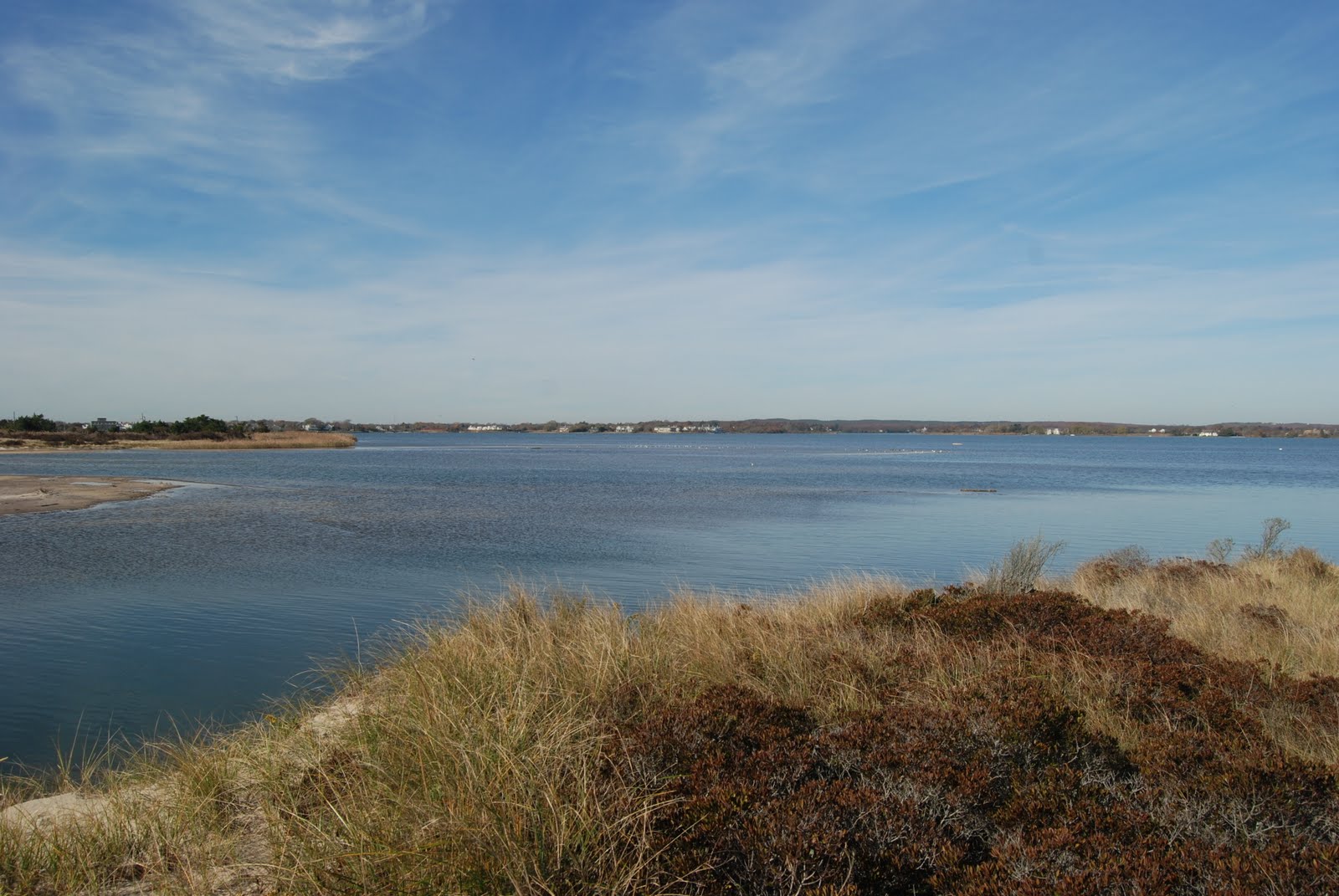
Mecox Bay

Mecox proved no more birdy than Sag, aside from a small group of Dunlin sitting on a small flat that had formed there.  However, while surveying the ocean side of the beach, Stella deftly located a Semipalmated Plover, a somewhat surprising bird this late in the year.
Semipalmated Plover-11/14/10

Just north of Mecox is a group of farm fields which have held many good birds in the past.  In the early '90s a Northern Lapwing spent some time there, and Cattle Egrets are almost annual in the fall.  Today was no exception, as at least three Cattle Egrets were loafing with the cattle at the Mecox Dairy.  While viewing the egrets a pair of Horned Larks flew overhead.
Mecox Dairy, Mecox, NY

When we arrived at Short's Pond in Scuttlehole, we were struck by the sheer numbers of geese on the pond.  A GWFG was here the day before, and chances were good for an unusual goose.  Also present was a small group of Pintail, some coots, a Green-winged Teal, and another Belted Kingfisher.  After tedious inspection, I evetually found a cooperative Cackling Goose.  It remained in the open for a while, allowing all three of us excellent views, and an opportunity to examine the nuances of this bird with the larger Canadas.

Shinnecock was cold and windy, but the birds made it worthwhile to remain outside.  As at Sagaponack good numbers of seabirds were offshore, with most, save for gannets, moving eastward.  Our first new birds for the day were a flock of Common Eider just inside the inlet.  Seth, after careful scrutiny of the hordes of Bonaparte's Gulls going by, skillfully picked out an immature Black-legged Kittiwake.  Unfortunately only Stella and he were able to attain views of the bird.  A small group of Boat-tailed Grackles was present by the Ponquoge Bridge.

After a delicious lunch at Orlando's in Hampton Bays, we stopped at Eastport Pond where good numbers of Aythya ducks were visible.  It provided all three of us with looks at our FOS Canvasback, 17 in total.  Also present were more of the expected waterfowl and a Belted Kingfisher.  Just as we were getting off the Sunrise Highway, Seth noticed a pair of Cattle Egrets.  This year certainly has been a banner year for the species, with at least 10 seen on Long Island, and even more throughout the northeast.

Our final stop was at Patchogue Lake for the previously reported Eurasian Wigeon.  The striking male was quite easy to locate, but also surprising were the large numbers of American Coot, 141 in total.

Highlights of the Day-
Black-legged Kittiwake
5 Greater White-fronted Geese
Cackling Goose
Eurasian Wigeon
Semipalmated Plover
7 Cattle Egrets
American Pipit
Horned Lark
Northern Pintail
Canvasback
Field Sparrow
Northern Harrier